
How to stand out in a crowd
Are you sleeping or waking up?
Imagine you’ve just gotten out of bed one morning. You’re groggy because you’ve had a terrible night’s sleep. Also, your neck is cramped and sore from lying on one side for too long. You went over budget on a new mattress just last month, so it must be your old pillow that’s responsible for the bad slumber. Now, imagine you’re walking down Main Street, and you see 4 stores, each advertising its wares. If you could only go into one store, which one would it be?
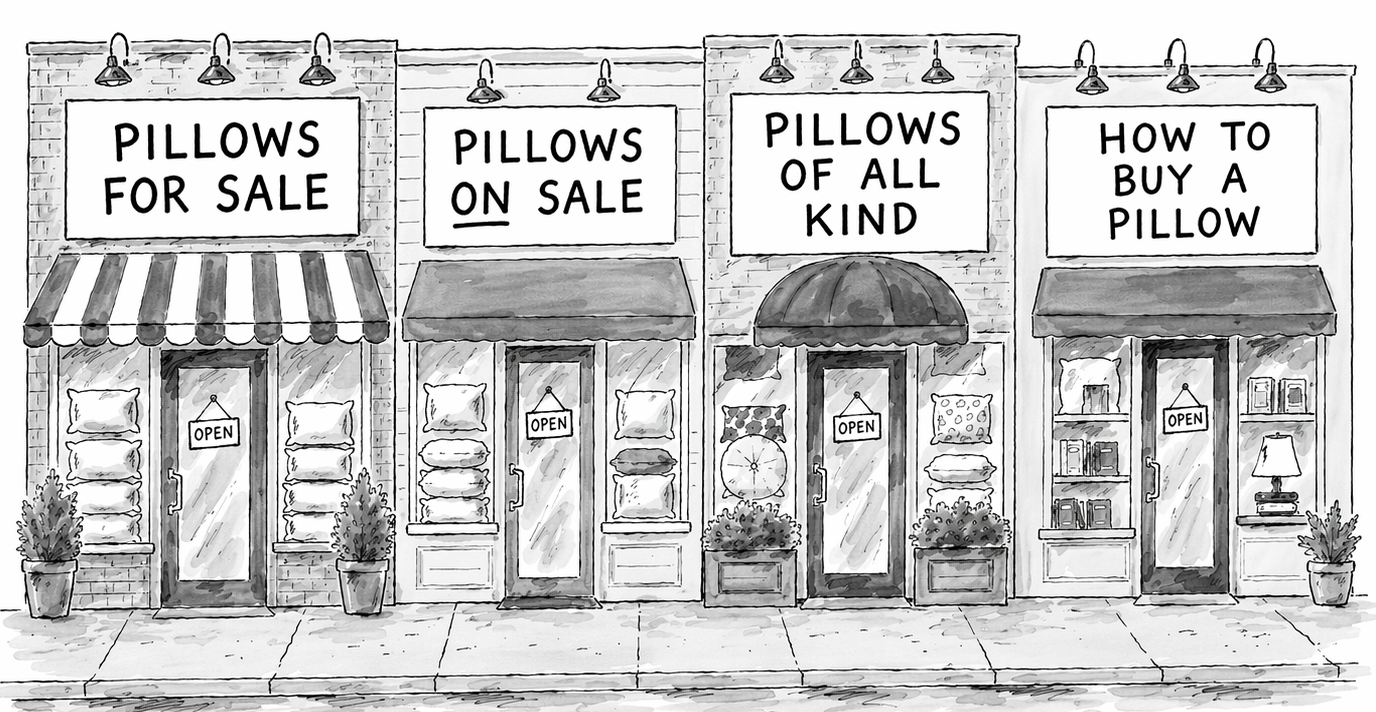 Did you choose to just buy a pillow, or save money on a pillow, or have a variety of pillows from which to choose? Or did you buy a way to think about what you should look for in a pillow? If you opted for one of the first three, then buy your pillow and go back to sleep. However, if you chose the store on the far right, then you bought a Method—an invaluable process for getting exactly what you need on the first try; and more importantly, one that will make you invaluable when curious pillow-shoppers go looking for answers. You just became a unique authority that sleepers trust. You just became one-of-a-kind. Good morning
I do, therefor I am.
ValYou.com
Here’s the fundamental inadequacy of models that brand you by your functional value: they ignore the first rule of branding—differentiation. People’s brains are incapable of valuing two or more identical entities. If no distinction is evident, then people will create one. I used to buy identical dolls for my twins. They would fight over them, and I’d point out that they were exactly the same. To which they each replied:
“No, this is the funny one,” said my humorous daughter.
“And this one’s good at sports,” my Tomboy insisted.
Unless you’re different, you will never be a brand. If everyone is valued by what they do, then no one’s that different, so everyone is replaceable. When one Detail-Obsessed leaves the organization, FedEx will find another one. In fact, at least 50 will interview for the position.
Old strategy models are well past their expiration date.
Yesterday’s identity models were developed just as the internet started to erupt. The tsunami aftershocks happened quickly and unrelentingly. Millions of people no longer work in corporate America. With the birth of the gig economy, empowered by the new media (blogs, podcasts, social networking forums, and self-published manifestos), personal branding is in demand by those who need it most: solo practitioners, influencers, owners of self-named businesses, creators, educators, entrepreneurs, politicians, performers, etc. They all vie to be one-of-a-kind, yet they all shout louder, chase popularity, and obsess about more, more more.
Today’s one-of-a-kind brands don’t need volume; they need clarity. Only one new identity model is purposefully designed to fulfill today’s challenges: Devention™—the strategic art of creative subtraction. Don’t dilute your identity. Distill it so only you can own it. Strip away false roles, signals and narratives until what remains can only be your one-of-a-kind personal brand.
Personal Branding—the purposeful curation of how you want people to know you—has evolved over the past 40 years to focus on “value.” That is, when you put your skills, talents, personality traits, experience and expertise in a blender, the resulting smoothie is more than the sum of its parts, and worth something to somebody. How much depends on a fairly complex dynamic—the interplay of uniqueness, versatility, consistency, productivity, risk and synergy with other smoothies. So, the application of today’s personal identity models inevitably comes down to branding you by function—What You Do. For an overly simplified example, if your brand stands for Detail-Obsessed, your value to cookie-cutter services (think FedEx) might be greater than it would be to, say, creative services (e.g., advertising agencies), where Big-idea Fountain drives profit, and Detail-Obsessed, while important, takes a back seat.
On the surface, the universal focus on value seems practical. It’s easy to understand, appeals to both employer and employee, and if you Google a few articles, you’ll find step-by-step templates to do it yourself at no cost. Such a simple process may be OK for assembling IKEA furniture, but would you bet your future happiness on something as vital as a divorce agreement?
How did it get this way? Yesterday’s personal branding models were tailor-made for corporations, and adapted from best-selling books that introduced breakthrough commercial strategies for market leadership. But people aren’t companies. And Commercial Strategy is not Personal Branding. The former is about improving efficiencies, maximizing profits and training talent to align with corporate goals, while the latter is about individuality, ambition and personal goals. As you might expect, these adapted models created the exact opposite of career expectations. Corporations—not employees—defined personal brand success, and not the other way around. Individuality became countercultural, and workers were reduced to a functional title: Junior Associate of Operations, Vice President of Client Services, Regional Sales Manager. IT guy.
Be a Method, not a title.
Show people what to do, and you’re a leader; show people how to think, and you’re a Method. Being a Method means that your unique personal character, style and approach are inseparable from work or success. It establishes that you are the technique—your singular presence and approach create the results, rather than a standardized system or formula. It implies you cannot be easily replaced or replicated because you are the core of the process. Henry Ford may be the inventor of the Model T, but his brand is the Method Man:
How to think about transportation;
How to think about talent management;
How to think about enriching the masses;
How to think about thinking—now that’s a store worth entering.